


What Fleet Managers Need to Know About the ZEV Mandate
As a fleet manager, it’s important that you understand the shifting EV landscape to ensure your fleet remains modern and fit-for purpose.
As a fleet manager, it’s important to understand the shifting EV market to ensure your fleet remains modern and fit-for-purpose.
Latest updates to the ZEV mandate

As of mid 2026, the ZEV mandate is in its third year of implementation. The long term goal of the mandate is still for car manufacturers to reach 100% zero-emission sales by 2035, but some ‘flexibility measures’ have been introduced to help manufacturers manage current market pressures. These include:
- As a result of these changes, fleet managers may consider shifting from ‘early adoption’ of EVs, to a more gradual transition.
Learn More About the ZEV Mandate and Fleet Insurance
What are the requirements of the ZEV mandate?

The ZEV mandate requires car and van manufacturers to sell an increasing percentage of zero-emission vehicles every year. It’s a scheme designed to phase out the sale of new internal combustion engine (ICE) vehicles so that by 2035, all newly sold cars and vans are fully zero-emission.
The requirements are laid out on a timeline over the course of the next 9 years (as of 2026) to phase out the selling of ICE vehicles. When the scheme began in 2024, the target was 22% for cars and 10% for vans. By 2030, 80% of new cars and 70% of new vans sold in Great Britain must be zero emission.
What the Zero Emission Vehicle mandate means for fleets
For vehicle fleets, the zero emission vehicle mandate will mean that there is a reduced number of ICE vehicles on the road over time. As a result, you will be more likely to need to consider electric options.
Whilst the transition to an EV fleet can be costly upfront, the long term savings resulting from cheaper operational costs and upkeep are likely to make your fleet more cost-efficient in the long run.
ZEV mandate deadlines
The ZEV mandate deadlines are as follows:
YEAR | Minimum ZEV Car Sales | Minimum ZEV VAn Sales |
|---|---|---|
2024 | 22% | 10% |
2025 | 28% | 16% |
2026 | 33% | 22% |
2027 | 38% | 34% |
2028 | 52% | 46% |
2029 | 66% | 58% |
2030 | 80% | 70% |
2031 | 84% | 76% |
2032 | 88% | 82% |
2033 | 92% | 88% |
2034 | 96% | 94% |
2035 | 100% | 100% |
Steps to prepare your fleet for the ZEV mandate

As car manufacturers begin to sell more and more electric vehicles, it’s important that you keep your fleet up to date with these changes. Electric vehicles are highly beneficial for most business fleets because they’re very efficient and cost-effective.
Here’s how to prepare your fleet for the ZEV mandate:
Request a Quote for Electric Fleet Insurance
As the UK’s leading fleet insurance specialists, we work with the UK’s largest insurance providers for fleets to get you an instant, hassle-free policy.
Implementing fleet electrification changes
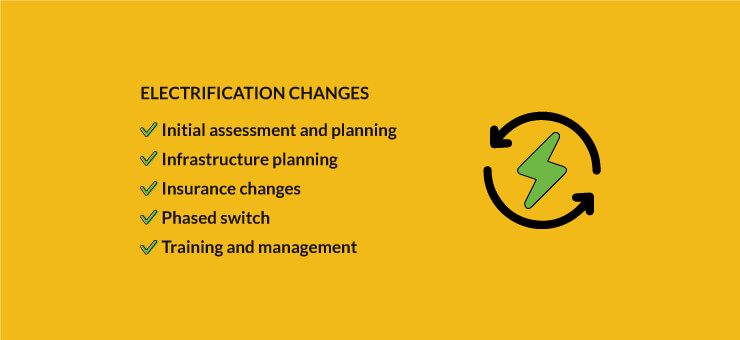
Depending on the size of your fleet, implementing fleet electrification often requires a phased, data-backed approach. Here are our key steps to a gradual switch to electric vehicles:
- 1Initial assessment and planning - Audit your current fleet to identify which vehicles you plan to switch first. Usual targets are those with predictable and shorter routes, which you can use to test the first phase. At this stage, you should also research government or local incentives to make the switch.
- 2Infrastructure planning - Assess the electrical capacity of your current premises and determine if upgrades to your infrastructure needs an overhaul to facilitate charging stations.
- 3Insurance changes - Research EV-specific insurance requirements or speak to fleet insurance experts to find out what changes you might need to make to your fleet policy.
- 4Phased switch - Begin with a ‘pilot program’, switching roughly 10% of your fleet to test the process and pinpoint snags or issues.
- 5Training and management - As you roll out your first phase of electric vehicles, provide comprehensive training to familiarise your drivers with features such a regenerative braking and instant torque. Monitor performance on the new vehicles (charging, range, energy use) and refine your strategies and route optimisation to maximise ROI.
Note: For smaller fleets of two or three vehicles, a single cost-benefit analysis and update to your insurance policies may suffice before you overhaul all of the vehicles together.
For any queries or insurance requirements as you transition to an electric fleet, contact FleetCover.
Chat to Us
Rather get a policy created over the phone? Speak with our experts now:
Get a Quote
Get a quick quote from an insurance professional with our easy form and a few details: